

In 1998, while at Yale Law School, I was the research assistant on a book called The Stakeholder Society, written by my tax law professor, Anne Alstott, and her colleague, Professor Bruce Ackerman. The proposal was to give every qualifying young American adult a one-time $80,000 citizen’s stake upon reaching adulthood to provide equal opportunity and financial resources. The book was well-received, the idea was roundly ignored by policy makers or denounced by conservatives. In fact, they claimed the funds would drain hundreds of billions of dollars annually out of the productive private sector, and ultimately harm the economy, decrease job creation, and potentially drive wealthy citizens (and their capital) out of the country.
On Thursday, October 1st, the United States Treasury opened investment accounts for more than 60 million American children. If your child is under 18 and has a Social Security number, there is now an account in their name, held in a trust the federal government runs. If your child is a U.S. citizen born between January 1, 2025 and December 31, 2028, they are also eligible to receive a one-time $1,000 U.S. Department of the Treasury deposit. Every kid under 18 has an account.
While not the mechanism proposed more than 25 years ago, the concept is still good. And no one at the White House celebration lamented how this transfer of wealth might cripple American capitalism. So, despite what the egomaniac-in-chief has named the accounts, I’m going to tell you to go claim yours.

Last summer, on this show, I called the tax law that created these accounts a betrayal. It cut Medicaid, the program that pays for about four in ten births in this country, and it put a $1,000 baby account in the same bill. I haven’t changed my mind about the cruelty of that law. But two things are true at once. A thousand dollars does not replace the prenatal care a mother can’t get anymore. And the money in that account is public money. It belongs to your child, not to the man whose name is on it.
Even if your kids can’t receive the $1,000 seed capital, families can add up to $5,000 a year. Employers can contribute. The money goes into index funds and stays there until the child turns 18. In addition, state governments, city and county governments, tribal governments and charities can put in unlimited amounts, as long as the money goes equally to a whole group of children.
But here’s the catch. The account Treasury opened last week is a shell. The $1,000 doesn’t arrive on its own. A parent still has to download the app, verify who they are, prove their relationship to the child in order to activate the account. Then they have to separately elect the payment. Until someone does that, the kid receives nothing and the family can’t add a dime.
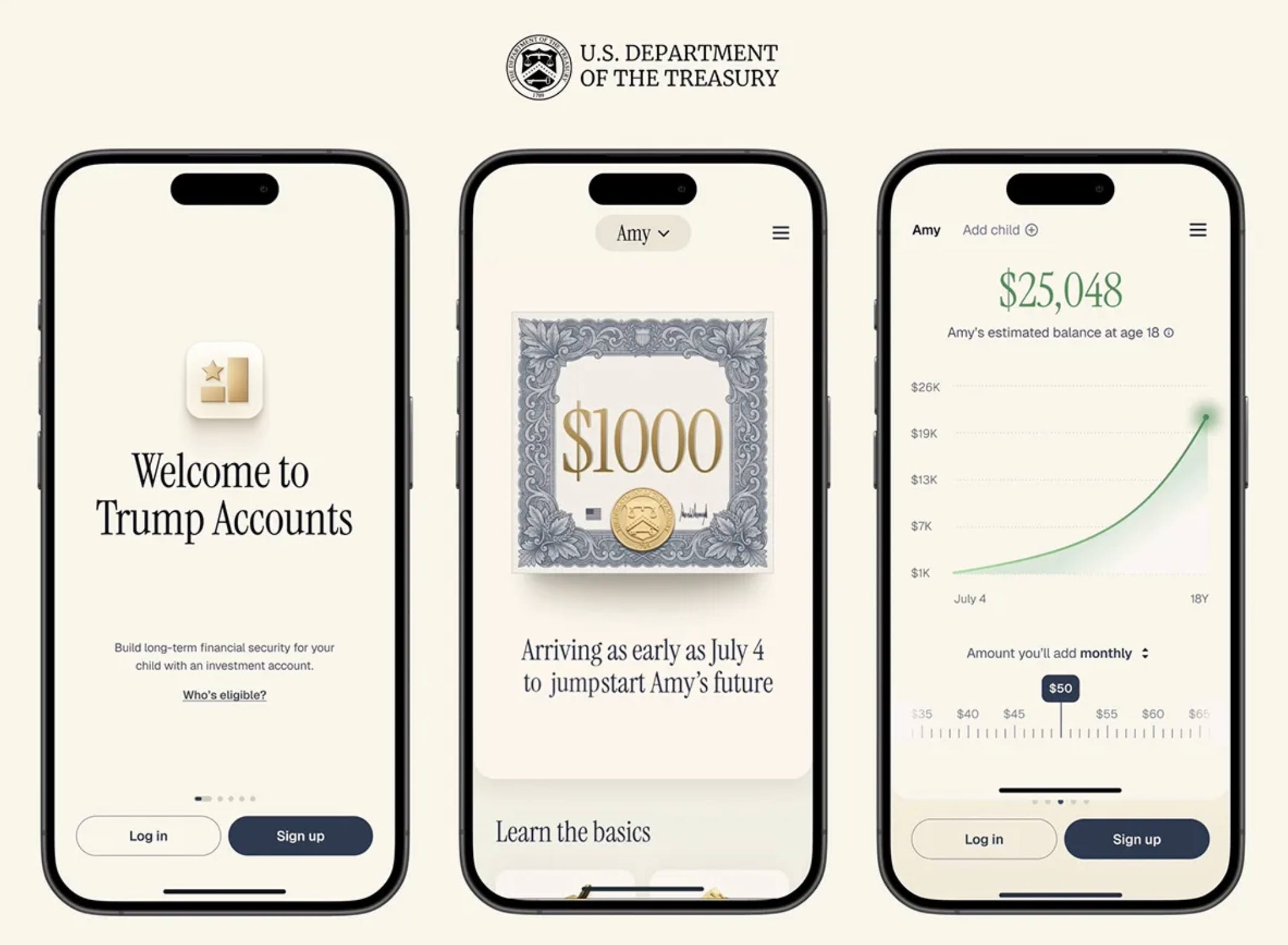
So who does that paperwork, and who doesn’t? We already know. By the end of July, when families had to sign up on their own, about 5.6 million children had been enrolled out of roughly 73 million who were eligible. Lower-income families were the least likely to sign up. Treasury’s own estimate was that opt-in enrollment would level off around half. After public complaint, Treasury switched to automatic accounts, finally abandoning the sleight-of-hand that is “opt-in” tax policy - but only for creating the accounts.
I started my career as a tax attorney, and this is the oldest story in the tax code. You have to know somebody or prove yourself to fully leverage the economic benefits of citizenship. The mortgage interest deduction, the 529 college plan, the dependent care credit: they all flow to the families with an accountant, a stable address and the time to read the instructions. Yet, when Congress let employers automatically enroll workers in 401(k)s in 2006, it was because the research showed that removing paperwork increased uptake from 37 percent to 86 percent. People didn’t suddenly start caring more about retirement. Someone changed the form and expanded the invitation.
Our tax code is largely designed to take without question but you have to grovel for a benefit - and the ones with the most information are the most likely ones to receive the funds. Requiring superior knowledge is a policy choice, even when it looks like an administrative detail. The largest tax breaks for wealthier households are mostly automatic. The breaks aimed at working families mostly have to be claimed, and the people who claim them are more likely to be audited.
The biggest breaks for wealthy families arrive on their own. Nobody files a form to get the step-up in basis when they inherit stock. Nobody applies for the lower rate on capital gains. But the credits meant for working families—the Earned Income Tax Credit, the Saver’s Credit, —have to be claimed, line by line. About one in five families eligible for the EITC never gets it.
The employer health insurance exclusion and retirement contributions through payroll are automatic - you don’t have to do anything special to qualify. But it’s not an accident that the tax credit for dependent care and the no tax on tips policy both require an opt-in. If you work, you have to work for it.
Which brings us back to the $1,000 per kid allocation. While the accounts are now automatic, families still have to claim the funds - a hurdle that millions might stumble over. But the cost of missing out for low-income kids is astronomical.
Consider this math: A $1,000 deposit at birth, left alone, could grow to around $243,000 by age 55. Add $5,000 a year, and the projection runs to $13 million. Same program, same account type, and the difference is whether the family can spare $5,000 a year and if they claimed the funds. And that takes knowledge and paperwork.
Left alone and without tweaks, this program widens the wealth gap - which this regime fully understands. The Congressional Research Service says the public contributions could narrow it or widen it, depending on which communities get them.
Connecticut figured this out first. Since 2023, it has set aside $3,200 for every baby whose birth is covered by the state’s Medicaid program, money the child can use as a young adult for school, a home or a business. Connecticut had to build its own system to do it. Now a federal system exists. A county commission could fund baby bonds for its children by sending one check to Treasury.
But only if the rules let that money reach the children who need it. Right now, Treasury will let a donor target children in a state, children born in certain years, or, under the rules it published last week, groups of ZIP codes with at least 5,000 children. It’s asking for comments on what income limit those ZIP codes should meet.
One option it floated is a median household income below the federal threshold for highly compensated employees, which is around $160,000. But to anyone who can read maps and Census data, this does not target need. The threshold covers nearly every ZIP code in America, which means those left out will still be left behind.
I sat through a lot of budget hearings in the Georgia General Assembly, and I also served on the Ways and Means Committee - a fancy term for the tax committee. In my monthly meetings with constituents, I always started with recent changes to tax policy - because where the government gets its money dictates how it will spend it. And the choice is rarely the ones who need it most. But that can change and it starts with $1,000.
Here’s what I’m asking you to do.
First, claim your child’s account. If you have a child under 18, claim the account through the Trump Accounts app or your IRS online account. If your child was born in 2025 or later, elect to receive the $1,000 - it’s their money. Then tell three families who might not hear about it: the parents at your daycare, your church, your kid’s school. If you run a program that serves families, whether that’s a clinic, a WIC office, a tax-prep site or a library, make claiming the account part of your intake.
Second, file a comment. Treasury is taking public comments on these rules through November 30th at regulations.gov. Tell them two things. Let donors target ZIP codes by real need, with an income line far below $160,000. And notify every family with an automatic account, in plain language and in more than one language, that money is waiting and how to claim it. Treasury already changed this program once because people commented. It can change it again.
Third, ask the people on your ballot. You’re electing mayors, county commissioners and state legislators on November 3rd. Ask them, by name and on the record: will you put public money into these accounts for the children in this community who start with the least? If your local foundation or community fund is looking for something to do, the federal government has now made it easy.
Regardless of why, the child accounts now exist. Who fills them, and for which children, will be decided by those who pay attention. Let’s make sure we invest in our kids and make them true stakeholders in a future they can afford.
Stacey Abrams standing up with the truth for democracy,thanks
Will the children not born in the target years get any money from the government now in their accounts?